

Arnljot Ask
Kurdistan comprises the following four regions: south eastern Turkey (Northern Kurdistan), northern Iraq (Southern Kurdistan), north-western Iran (Eastern Kurdistan), and northern Syria (Western Kurdistan). Some definitions also include parts of southern Transcaucasia.
Approximately forty five million Kurds live in the Middle East—and they comprise nearly one-fifth of Turkey’s population of seventy-nine million. According to a report by the Council of Europe, approximately 1.3 million [of the total 45 million] Kurds live in Western Europe. The earliest immigrants were Kurds from Turkey, who settled in Germany, Austria, the Benelux countries, the United Kingdom, Switzerland and France during the 1960s.
Historically, the word “Kurdistan” is first attested in 11th century Seljuk chronicles. Many disparate Kurdish dynasties, emirates, principalities, and chiefdoms were established from the 8th to the 19th centuries. Administratively, the 20th century saw the establishment of the short-lived areas of the Kurdish state (1918–1919), Kingdom of Kurdistan (1921–1924), Kurdistansky Uyezd i.e. “Red Kurdistan” (1923–1929), Republic of Ararat (1927–1930), and Republic of Mahabad (1946).
During the Kurdish–Turkish conflict, food embargoes were placed on Kurdish villages and towns. There were many instances of Kurds being forcibly expelled from their villages by Turkish security forces. Many villages were reportedly set on fire or destroyed. Throughout the 1990s and early 2000s, political parties that represented Kurdish interests were banned. In 2013, a ceasefire effectively ended the violence until June 2015, when hostilities renewed between the PKK and the Turkish government over Turkish involvement in the Syrian Civil War. Violence was widely reported against ordinary Kurdish citizens and the headquarters and branches of the pro-Kurdish rights Peoples’ Democratic Party were attacked by mobs.
Although the Kurdish population has for centuries been concentrated over large parts of what are now eastern Turkey, northern Iraq, and western Iran as well as smaller parts of northern Syria and Armenia, it never achieved nation-state status. Kurdish aspirations for self-determination were often ill-received, and Kurds historically experienced persecution or pressure to assimilate in their respective countries; the Kurds of Turkey were hounded at the hands of the government.
Major social changes in Turkey contributed to the proliferation and radicalization of Kurdish nationalist groups in that country in the 1960s and ’70s. The PKK was among the various groups that emerged, formally founded by Öcalan in late 1978 as a Marxist organization dedicated to the creation of an independent Kurdistan. At its foundation, the PKK distinguished itself by its social makeup—its members were drawn largely from the lower classes—and its radicalism; the group espoused violence as a tenet central to its cause and demonstrated early its willingness to employ force against Kurds perceived as government collaborators.
An armed rebellion broke out in 1984 in the Kurdish-majority south east of the country, led by the Kurdistan Workers Party (PKK), which was in turn met with a brutal military campaign in which at least 40,000 people were killed and at least 2,400 villages destroyed by the Turkish armed forces. The Kurdistan Workers’ Party (PKK), established by Abdullah Ocalan in 1978, has waged an insurgency since 1984 against Turkish authorities for greater cultural and political rights, primarily with the objective of establishing an independent Kurdish state.
Under the Erdogan regime, popular discontent has steadily increased, as seen in the June 2013 Gezi Park protests and a July 2016 coup attempt, but tensions have also risen between Turkish authorities and Kurdish groups. In particular, the PKK, the Peoples’ Democratic Party (HDP) (a left-wing pro-Kurdish party), and the People’s Protection Unit (YPG) (the armed wing of the Syrian Democratic Union Party (PYD) with ties to the PKK) have increasingly agitated against the government, conducting numerous attacks against Turkish authorities in the southeast.
Öcalan, the founder and undisputed leader of the PKK, was kidnapped from Kenya and brought to Turkey on 15 February 1999 by an international Secret Service action and has been on the prison island of Imrali for 25 years, where he is held incommunicado. During the 1980s and ’90s, PKK attacks and reprisals by the Turkish government led to a state of virtual war in eastern Turkey. In the 1990s Turkish troops also attacked PKK bases in the so-called safe havens of Iraqi Kurdistan in northern Iraq (created in the wake of the Persian Gulf War [1990–91]), first from the air and then with ground forces. In February 1999 Öcalan was captured in Nairobi and flown to Turkey, where in June he was convicted of treason and sentenced to death. Following Turkey’s abolition of the death penalty in August 2002, however, his sentence was commuted to life in prison the following October.
The PKK is a Kurdish militant political organization and armed guerrilla movement which historically operated throughout Kurdistan but is now primarily based in the mountainous Kurdish-majority regions of south-eastern Turkey and northern Iraq. Since 1984, the PKK has been involved in asymmetric warfare in the Kurdish–Turkish conflict (with several ceasefires between 1993 and 2013–2015).
In July 2015, a two-year cease-fire between Turkey’s government and the PKK collapsed following a suicide bombing by suspected self-proclaimed Islamic State militants that killed nearly thirty Kurds near the Syrian border. Following the coup attempt in July 2016, Erdogan cracked down on suspected coup conspirators, arrested an estimated fifty thousand people, and increased air strikes on PKK militants in south eastern Turkey. He also stepped up military operations in Syria against the YPG and the self-declared Islamic State, deploying tanks, Special Forces, and air support in Turkey’s first major offensive. Turkey largely succeeded in pushing the Islamic State out and securing the captured areas under Syrian rebel control, preventing the YPG, which Erdogan calls a terrorist organization, from expanding its control to the western bank of the Euphrates River along Turkey’s border.
In the 2 years to July 2017, following the breakdown of the ceasefire, the Turkey-PKK conflict killed almost 3,000 people, including 1,378 PKK fighters, 976 state security force members, 408 civilians, 219 “youths of unknown affiliation”, according to the International Crisis Group.
With the recent elections the PKK has launched candidates for the legal party – Party for equality and Democracy (DEM) – to run candidates for the local election in Turkey. Erdogan tried to hinder them, like he did with the HDP (Peoples Democracy Party) during the National Elections last spring. Then they had to change the name to The Red Green Party (YSGP), which gained 61 MPs (out of 600) seats in the National Parliament. It is still the third largest party in the Parliament.
Recently politicians from the DEM and DBP parties announced at a press conference in Amed that from 1st to 15th February, demonstrations under the slogan “Time for Freedom” will be held in all cities in the Kurdish provinces of Turkey in order to break Öcalan’s isolation, said DBP chairperson, Keskin Bayindir.
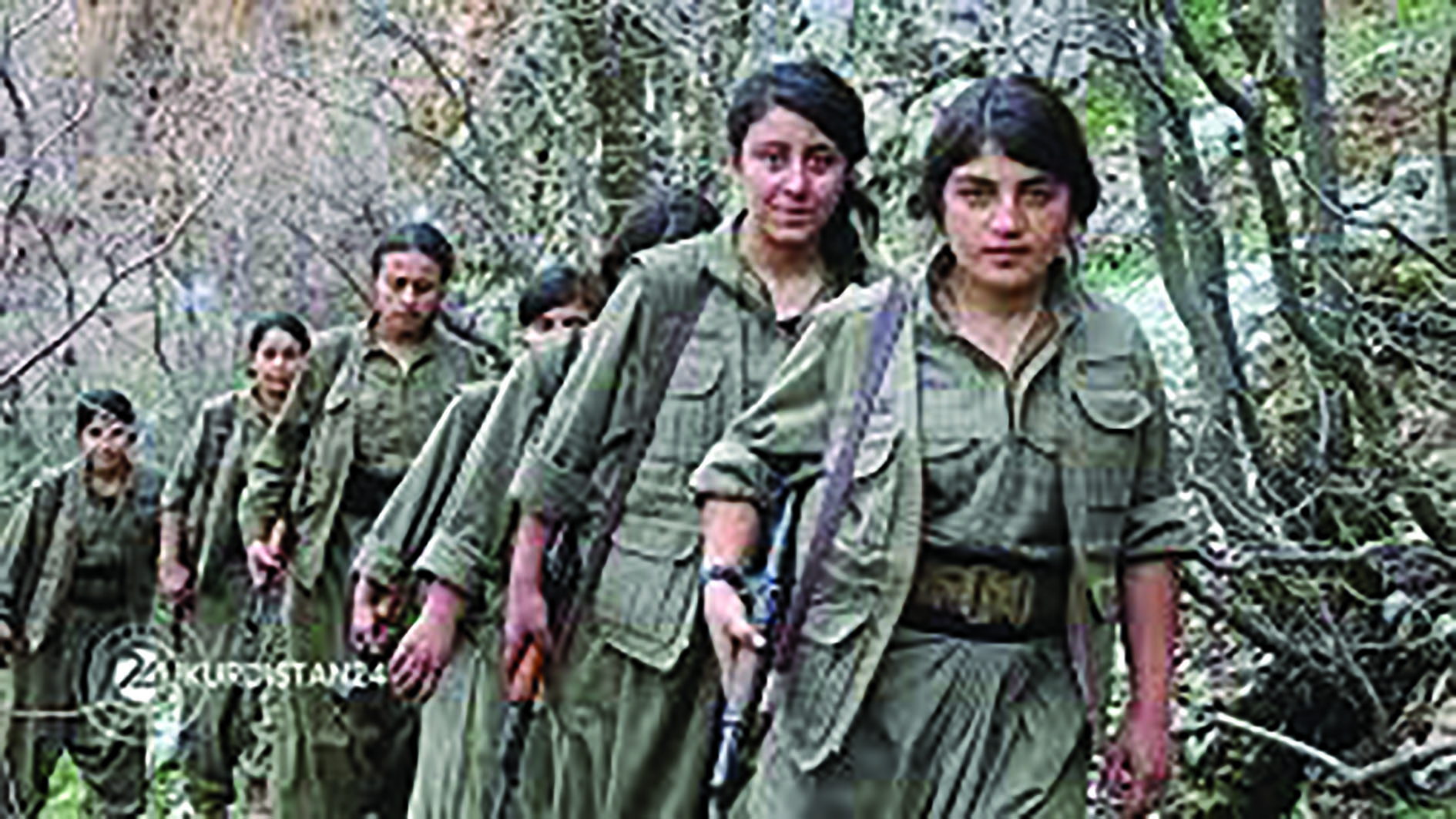
WOMEN IN THE PKK
On 30 July 1996, Zîlan, a female PKK guerrilla, detonated a bomb in the middle of a military parade in Dersim. Before that she sent a letter to the exiled party leader Abdullah Öcalan in Damascus that stated:
I want to be part of the total expression of the liberation struggle of our people. By exploding a bomb against my body I want to protest against the policies of imperialism which enslaves women and express my rage and become a symbol of resistance of Kurdish women. Under the leadership of Apo [Öcalan], the national liberation struggle and the Kurdish people, will at last take its richly deserved place in the family of humanity. My will to live is very strong. My desire is to have a fulfilled life through a strong action. The reason for my actions is my love for human beings and for life!
This suicide attack was the first of its kind and had a huge impact on the women, the party and Öcalan himself. With her suicide attack, Zîlan became the new symbol of women’s resistance and determination for generations of women who came after her. Shortly after the attack, Öcalan started calling the PKK a ‘woman’s party’, in order to make official women’s important contributions and central role in the movement as a whole (interview with former commander, [14 May Reference Öcalan 2018). This signified an important shift for women who had spent years fighting for recognition within the male-dominated party structures. ‘We had to fight in order to be able to fight’, a former commander told me about her experience of the power struggles with men in the party in the 1990s. Zîlan’s act, however, made it impossible for any male member of the movement to question her and, by extension, women’s dedication to the cause. Yet, in the day-to-day struggle, many of my respondents recounted how their male comrades actively sabotaged the women and their nascent party structures, especially after Öcalan’s arrest in 1999.
Women comprise 30% of the PKK. Through democratic confederalism and feminism, women have created alternative forms of social organization which counter dominant patriarchal structures. Through engaging in militarism, women have also physically and directly resisted patriarchy and domination. In addition to centuries of colonial and imperialist domination by Western powers in general, the Kurds have long been subjected to pan-Arab nationalist domination which by definition excluded other non-Arab ethnic groups such as the Kurds (Knapp et al., 2016).
Democratic confederalism” is Öcalan’s own idea of a “democracy without a state” (Öcalan, 2017, p. 39). The tenets of democratic confederalism are radical democracy and democratic autonomy. Democratic autonomy entails a society that is structured around self-organizing, self-governing, participatory, decentralized, and bottom-up units of decision-making (Knapp et al., 2016). The bottom-up participatory units of government enables the broad participation and free expression of all societal groups, regardless of ethnicity, gender, religion, cultural identity, party-affiliation, or ideology (Öcalan, 2017). In practice, democratic confederalism in Rojava was introduced already in 2011 by the PKK-linked PYD (Democratic Union Party), one of the main Kurdish Syrian-opposition parties and the political counterpart of the Kurdish military unit YPG/YPJ, who initiated the establishment of the People’s Council of West Kurdistan (MGRK) (Knapp et al., 2016). The MGRK organized the new society into councils, commissions and coordinating bodies, and elected the coordinating body TEV-DEM (Democratic Society Movement— Tevgera Civaka Demokratik). According to Knapp et al. (2016), the MGRK system consists of four levels of autonomous and self-organized councils, connected through a bottom-up pyramid structure. The smallest council is the commune, which further extends through the neighbourhood and district level up to the MGRK or People’s Councils, who in turn represent each of the cantons of Rojava (Shahvisi, 2018).
While each level is represented at the higher levels of organization, power and authority arise from the lowest level, the commune. In the commune, each resident is free to be involved in all forms of decision-making processes, thus ensuring a decentralized, participatory, bottom-up, and grassroots structure of organization (Öcalan, 2017).
As Şimşek & Jongerden (2018) suggest, the Rojava revolution and women’s “embrace of the political” came together with Kurdish women’s performance of new subjectivities and the emergence of women as “self-determining actors” (p. 17). Thus, women in Rojava have through democratic confederalism and feminist principles resisted against domination from oppressive nationalist and patriarchal structures, by countering gendered perceptions of women as agentless and submissive and instead performed enacted new forms of political and cultural subjectivities.
The women nevertheless managed to establish their own army (1995) and party (1999) within the PKK. Since then, their party structures have developed and diversified into all cultural, political and military realms in different parts of Kurdistan and Europe as well, most visibly so in the form of the female fighters in Rojava, the co-mayors in Bakur and the development of Jineolojî. It contains one of the largest contingents of armed women militants in the world. It has battled the huge Turkish army for nearly three decades, in the name of greater Kurdish autonomy.
Today, one can imagine the Kurdish Freedom Movement and its organisational structure like a tree that over the past decades has grown more and increasingly versatile roots. Depending on the political space available, the party and the women’s structures can branch out more or less in the respective regions. Until 2015, this was the case in Bakur and continues today in Rojava and the Maxmûr refugee camp, where the organisational structures go down to the neighbourhood level with communes and cooperatives organising daily life. How much the party and its women can do in each region is constantly changing, and the boundaries between armed and political activism are often fluid. Under Ocalan, who is now in prison, the PKK attempted to reinvent itself as “a social movement with self-administration at local levels, an alternative type of economy, ecology and feminism as central pillars.
Here we [local reporters] will continue to investigate how women got to play such a central role within the PKK, how the ‘free woman’ came into being and how that resulted in semi-autonomous organisational structures and the development of Jineolojî. Analysing the women’s struggle alongside the development as a movement as a whole will allow me to discuss the duality reinforcing the persistence of women’s everyday resistance and Öcalan’s ideological production (Reference Al-Ali and TaṣAl-Ali & Tas 2018). This chapter is based on existing (academic) literature, as well as ethnographic research (2015–2019), namely in-depth interviews with both current and former female members of the Freedom Movement, in the armed and political spheres. The chapter is by no means a complete history of the Kurdish women’s movement, but is intended to be read in tandem with other accounts that analyse the rich and complex history of the movement and its individual members struggling to realise their particular version of liberated women and a liberated Kurdistan (Çağlayan 2020; Reference DirikDirik 2021). The PKK’s gender policy, which includes maintaining a fighting force that is 40% female and the promotion of women’s liberation as a key component of its political platform, makes the PKK an outlier among both Kurdish nationalist groups and leftist armed movements in the Middle East.
Meanwhile, the main Kurdish party in the Turkish parliament, Peace and Democracy (BDP), applies a minimum 40% women’s quota and always has a man and a woman as joint party presidents.
But Dr Kariane Westrheim, a Norwegian academic who conducted field work among female PKK militants in the Qandil Mountains in northern Iraq, says: “Even if the PKK had gender issues on the agenda, and also female co-founders, women have struggled hard to get their voices heard and to develop their own organisational structures”.
Doğan [Doğan Abukay, Turkish experimental physicist and academic. Doğan Akhanlı (1957–2021) ] writes: “While our multifaceted negotiations continue as a party in favour of the broadest union of forces, a statement regarding Dersim has been made. We know that Dersim [ Dersim Province (Kurdish province in the Eastern Anatolia Region of Turkey. Its central city is Tunceli] cannot exist without DEM and DEM cannot exist without Dersim. In Dersim, EMEK Party, Socialist Assemblies Federation (SMF), Labour and Freedom Front, and Turkish Workers’ Party announced their decision to work to establish an alliance in the 31 March elections. Our negotiations are continuing. As DEM Party, we continue our work on the basis of the urban reconciliation strategy. Dersim, among these provinces, has a special importance for us. Because, let’s remember that Dersim is one of the provinces that was taken from us by trustees in the previous period.”
The prosecutor filed a case accusing the Peoples’ Democratic Party – or HDP – of colluding with a banned Kurdish militant movement. The HDP, which is the third-largest party in Turkey’s parliament, denies any links to the militants.
Bayindir said at the press conference that the Kurdish people see Öcalan as a crucial figure in the fight for equality, justice and freedom and the total isolation he is subjected to is illegal and inhumane. The aim of the week of action is to enforce the rights that all prisoners are entitled to under Turkish law and international standards.
The Kurdish question is central to a nationality issue in Europe and also a democratic one where the US and their Arab allies have not been able to make it an Islamic issue.
 admin
admin