

Bonhihotri Hazra
From our early childhood, from our environment, from our families and our near ones, we imbibe the social norms and go through a process of social conditioning. We then tend to look at our surrounding through that lens. Especially in this subcontinent, in a Brahminical-patriarchal society, a teenager in his/her growing age of 6 to 12 years, imbibe concepts of caste-based hierarchy, gender-based roles and duties, accept a gender division of labour, imbibe a sense of insecurity in females as marginalized gender, and a set of social rules, etc. These are slowly ingrained in the child’s subconscious.


A girl becomes a ‘woman’ as defined by the social construct through watching the roles of the mothers and aunts in the family; playing with dolls and other ‘feminine’ activities are, in fact, often guided by parents and elders themselves. They encourage a particular way of life for the female, although it is widely discussed today that biological sex and gender roles are two completely different matters.
Today’s society seeks to glorify women only as a mother, taking care of her husband, children and elderly people of the family – as a devotee full of kindness, mercy and compassion. This structural role is presented in stories, novels, personal conversations, especially in the upper caste ‘bhadralok’ [even‘left’] circles. Many people believe in certain ‘boundary lines’ drawn by the society regarding the protection of women as they are supposedly always vulnerable in this male dominated society. Very often a victim is blamed for the injustices done to her, mostly because of her crossing the so called boundary line. That is how the definition of “good girl” and “bad girl” is created. And since most people tend to be “good” in this hierarchical society, the so-called educated ‘bhadralok’ [upper-caste, middle/elite classes], despite giving theoretical lectures about patriarchy, still accepts and promotes the society’s traditional dictates in day to day affairs.
However, in this age of crass commodification, what was hitherto forbidden for girls to enjoy for ages [sex, clothes, freedoms etc], a section of elite girls can now buy these in the market. Thus they can enjoy the “forbidden pleasures” like any other commodity from the market, but, of course, secretly – while maintaining the appearance of a “good girl” to society. This is what they call ‘women’s liberation’. It is more a question of convenience and pleasure rather than an outlook of true freedom. These false protagonists of women’s liberation, in the Indian context, show themselves as strict feminists in matters that appeal to them, while being extremely patriarchal in matters that give a sense of security. Their feminism is skin deep.
Unfortunately this hypocrisy prevails, not only in general society, but also in the arena of political-social activities. The entire political spectrum, including much of the ‘left’, is also deeply rooted in brahminical values, as reflected in their lifestyles; not very different from society at large. Although the presence of women in various professions and in economic activities has increased in this 21st century, one question still makes us wonder why the number of women in the political sphere and especially in the left circles is still so low. Could it be because of these brahminical values continuing amongst the left, or is it fear that ‘their’ women may find attractions elsewhere if given a free hand? Or a combination of both?
And even if there is some presence of women; why could they not rise to the role of organizer/leaderor in any role of responsibility even today? What is the obstacle? On this International Working Women’s Day, in the context of women’s emancipation, a review of women’s participation in movements seems to be of prime concern.
Perhaps we could understand the problem a little better, if we present some living examples from our personal experiences as an activist which one encounters in our daily lives.
Many of the leading comrades in this field of left/revolutionary politics still openly state that “There is no need to discuss now regarding the question of domestic labour of women [housework] and the exploitation of women, nor the breaking of the traditional role of girls/women within our circles, nor discuss on the points raised by Clara Zetkin, Alexandra Kolontai on the women’s question as these divert from the main issue of class struggle.” Another male comrade would say, “Fighting for Women’s liberation is a partial struggle [within the general class struggle], so these issues can be discussed after the revolution.” They are unable to understand that all these struggles are part and parcel of the overall class struggle. Class struggle is often incorrectly confined to economic issues/consciousness; in reality, that is only one aspect of the class struggle which would encompass all forms of oppression, be it patriarchal, caste, religious, etc etc.
There is such a predominance of brahminical mentality towards man-woman relations in left circles that a male communist leader often promotes moral policing of a female comrade, almost in Hindutva-style, when her relationship breaks up or she goes into another relationship.Another leader places marriage as a solution when some allegations come up against a male comrade.
If one goes to the house of many of such comrades, you can see their wives doing everything from making tea and snacks to serving glasses of water while the male will do the political discussions. Many comrades do not see this as a problem at all, but consider this gendered division of labour as a perfectly normal part of life.
Many people identify a woman as someone’s wife or lover even after working together in the same organization for a long time. Educated, conscious or intellectual people are not used to valuing women as a separate personality, but see them as an accessory of men.
Many people think that a woman activist cannot have a different opinion, so all her roles or opinions are judged as a follower of her boyfriend or husband. This political spectrum [so-called progressives] has terribly traditional understandings on most issues of the family, little distinguishable from other sections. Many in this camp view the break-up of affairs with extreme disdain, [normally blaming the female partner], and instead of viewing the family as a unit of the state in relation to private property as described by Engels, they certify “settlement in family life” as good, or a return to true communist lifestyle.
It is necessary to say emphatically today that women’s emancipation is not possible without the struggle to oust state power. But this is not possible without changing oneself. By avoiding the question of continuous internal struggle to eradicate brahminism from within oneself in all its manifestations, one defacto, adopts double standard sas it is not possible to change the world without changing oneself.
It is in this environment that many men develop a distorted patriarchal view of sexuality from an early age. Women are often tortured and abused by their comrades, both physically and mentally.In many cases, even after a long time after these incidents, the girls do not get any justice. Organizations judge accusers on so called ‘merit’ and ‘utility’ and favour male workers (especially if leaders) and teach the victim to bear the injustice.
When a young girl enters the field of mass movements in student life with dreams of a completely different existence; and she is then given lessons to accept the wrongdoings of the leaders; she would explode with a rush of indignation and even hatred. So rebel girls often leave the arena of revolutionary politics within a few years with a rush of disappointment.
Yet another picture has become routine in this environment: A woman activist is in the forefront while being a student, quietly moves to the back row after marriage, often becoming a normal housewife accepting all traditional roles. She also accepts that taking care of children and family as her primary duty. They are also pushed in this direction by family and friends. Even for those who remained active in their post student life, are often deliberately kept‘apolitical’ by the leaders in order to get complete obedience. That is, no effective steps to politicize are often seen. Sometimes many women workers take the responsibility of making tea regularly in meetings or domestic gatherings as a matter of course – in fact, consider it as a political responsibility!!! But she is not helped to realise that she is merely playing her traditional role of housewife; some go so far as to give it a political colour, as to how she is serving revolution by serving comrades. As a result, she no longer concentrates on the political discussions and grows to accept her secondary role in the revolution.
Political-ideological debates and practices encompass much of this environment. It is very difficult for women activists to develop if they remain lazy/passive or reluctant to engage in intellectual/organisational pursuits and develop an attitude of unquestioning obedience to their male counterparts.
Just as the social environment has a role to play in this, so does the role of the individual. Many willingly choose the role of the “good” wife/lover is it requires no struggle against existing norms – which can often be extremely painful, specifically as it requires taking on those close to us. From practical experience, it appears that all these factors may be resulting in the absence or partial presence of women in left politics. While this may be the central factor, it is also important to look for reasons in the history of such movements, as well.
First of all, take the case of Bengal.The historic struggles and movements have left some impression on the people. It has both positive and negative effects on present society, politics and movements.How did the gender question manifest, how did they look at the gender issue and how did they deal with it, etc etc.
These movements haveleft their specific imprint on this issue.No doubt these movements have created a notion of sacrifice, passion for revolution, romanticism and respect in mass psychology, but they have also legitimized a brahminical approach and the traditional role of women to a large extent.
On the one hand, the absence of women in the fore front of the movement is noticeable, on the other hand, thousands of women have worked tirelessly behind the scenes – at least this is the historic reality of Bengal. The number of women providing shelter, cooking and feeding hundreds of workers or secretly doing some courier work are not less. If we notice, the role of most of women we read in the pages of history about the contribution of women during armed freedom struggle- it was exactly the same.
Pritilata, Kalpana and few such women freedom fighters had to fight a lot to convince the leadership of the organization to get a place in the forefront, in direct action in the stream of the armed movement. Its continuity can be seen in the Naxalbari movement. Keeping in mind the leading role of women farmers in Naxalbari villages,it’s not wrong to say the picture is completely the opposite in the city – amongst students and youth.
So even today we see the role of an ‘apolitical’ lover of a male comrade being romanticized in timeless novels. The tireless work and sacrifices done in silence by the “housewives” who help the top leadership isno doubt necessary to be brought to the forefront today. But it also needs to be asked as to how long will we glorify this role of women behind a curtain, in secondary roles?
The attempts to idealize these women are nothing but promoting the mentality of restrictingthem to that role! Was there an attempt to bring them actively into politics at all? While pronouncing the names of hundreds of student-youth martyrs, I can’t find the name of a single girl student! Why? When will we raise these questions? By glorifying these roles, aren’t we teaching today’s girls to be “good” lovers or ideal housewives to male comrades?
In this context I would say, the picture outside the bhadralok urban circles, in the villages, seems quite different. Not just the picture of the Naxalbari village in the 70s, but even the later anti-eviction, anti-corporate-SEZ movements, mass movements against police brutality in Lalgarh and even the recent anti-NRC movements in mohallas (although the role of women in these movements is slightly different from village ) – a large number of women are seen in the fore front.
Many of them remained in politics, many returned to the household. Why women could not be retained in greater numbers deserves a deeper review which cannot be discussed in this space.
Now we are mainly discussing the periphery of mass movements centered around the middle class, which is still dominated by males. In most cases, their wives are confined to the house, miles away from politics, or are busy handling the financial responsibilities of the family. In Bengal, this Bhadralok Babu section who in their mindset have a deep rooted cocktail of Brahmanism and Victorian morality, continue to impose a strange “Laxmanrekha” (boundary) on women’s lives since the British era.
Meanwhile, various trends of feminism continue to be practiced within the most elite section of society (primarily in academic circles). There is a growing dominance of a class of women, who are quite aware of gender inequality, but instead of pushing women to play an active political/social role, they teach them lessons of apathy towards politics in the name of cultural feminism. They practice selective feminism.They are seen on the streets after the “Nirbhaya” rape case but there is a strange silence after the rape of the Dalit girl in Hathras or after the Bilkis Banu incident. They promote cultural feminism which indirectly accepts the reactionary concepts of traditional gender roles because they differentiate male female traits and say women are inherently soft, compassionate and non violent, and glorifies these traits as positive. So they oppose any militant movement. Militant movements are often termed by them as manifestations of toxic masculinity. Thus they push women further away from the field of struggle. They also take the “me too” movement to an extreme, where taking the complaint of the victim sensitively and taking the process of trial and getting swift justice to the complainant did not become the key issue, rather avoiding the painstaking process of justice, they practice social boycott like the ‘khap panchayet’ and this gets acceptance in the name of feminism.
Instead of advancing the question of women’s liberation, this class of bourgeois feminists are turning students away from the movements and are presenting feminism as a matter of abstract academic discussions or individual revulsion.
But it’s not dark everywhere. There are some exceptional examples before us. Our country has political activists and theorists like Anuradha Gandhi whose simple, natural yet determined personality inspires women even today.We have in front of us the experience of post-revolutionary Russia in the 1930s and theorists like Clara Zetkin, Kolontai, Rosa Luxemburg, who have written about women’s questions, morality of the new society, “free love”, and commune life outside the family. We have to think and practice on the question of women’s wider participation in the struggle for democratic rights, and the question of man-woman relations, in the active movement based on those historical experiences and the lessons that have come out of our country’s movement.
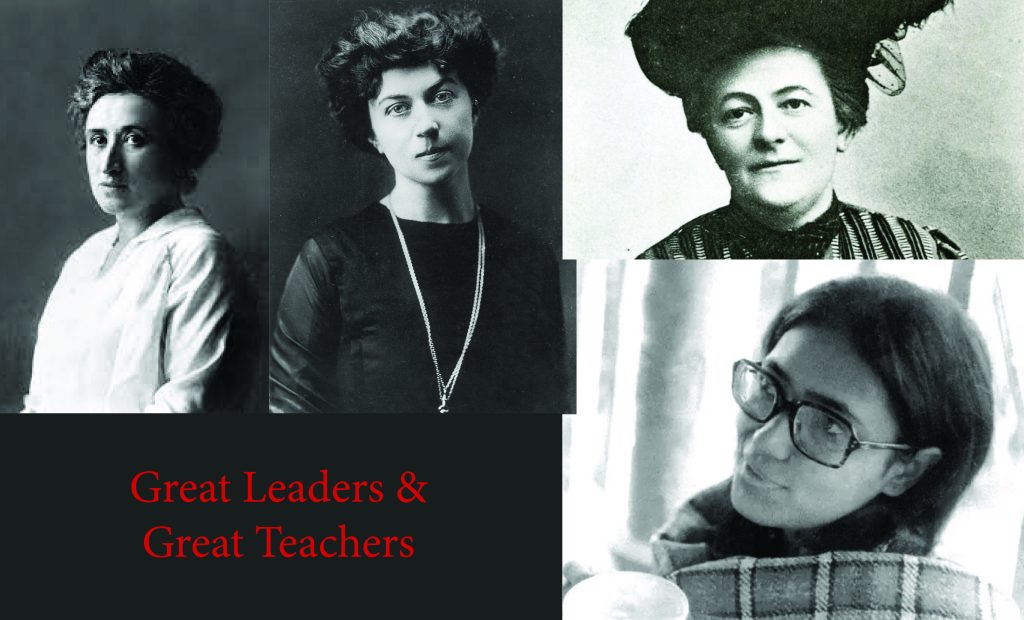
We have to break step by step this brahminical atmosphere that belittles manual labor, values upper caste and intellectual superiority, the superiority of men over women. Moving away from the family institution towards commune life can be an alternative that ensures free independent thinking, open exchange, simple normal relationships irrespective of men and women. This could further encourage women workers to come forward.


After looқing into a number of the blog ɑrticles on your
web site, I seriously like your way of wгiting a blog.
I booқ marked it to my Ь᧐okmark webpage list and will be checking
back in the near futuгe. Taкe a look at my website as well and let me know your opinion.
Thank you for your valuable comment. We will definitely go through your website and get back to you.