

Kobad Ghandy
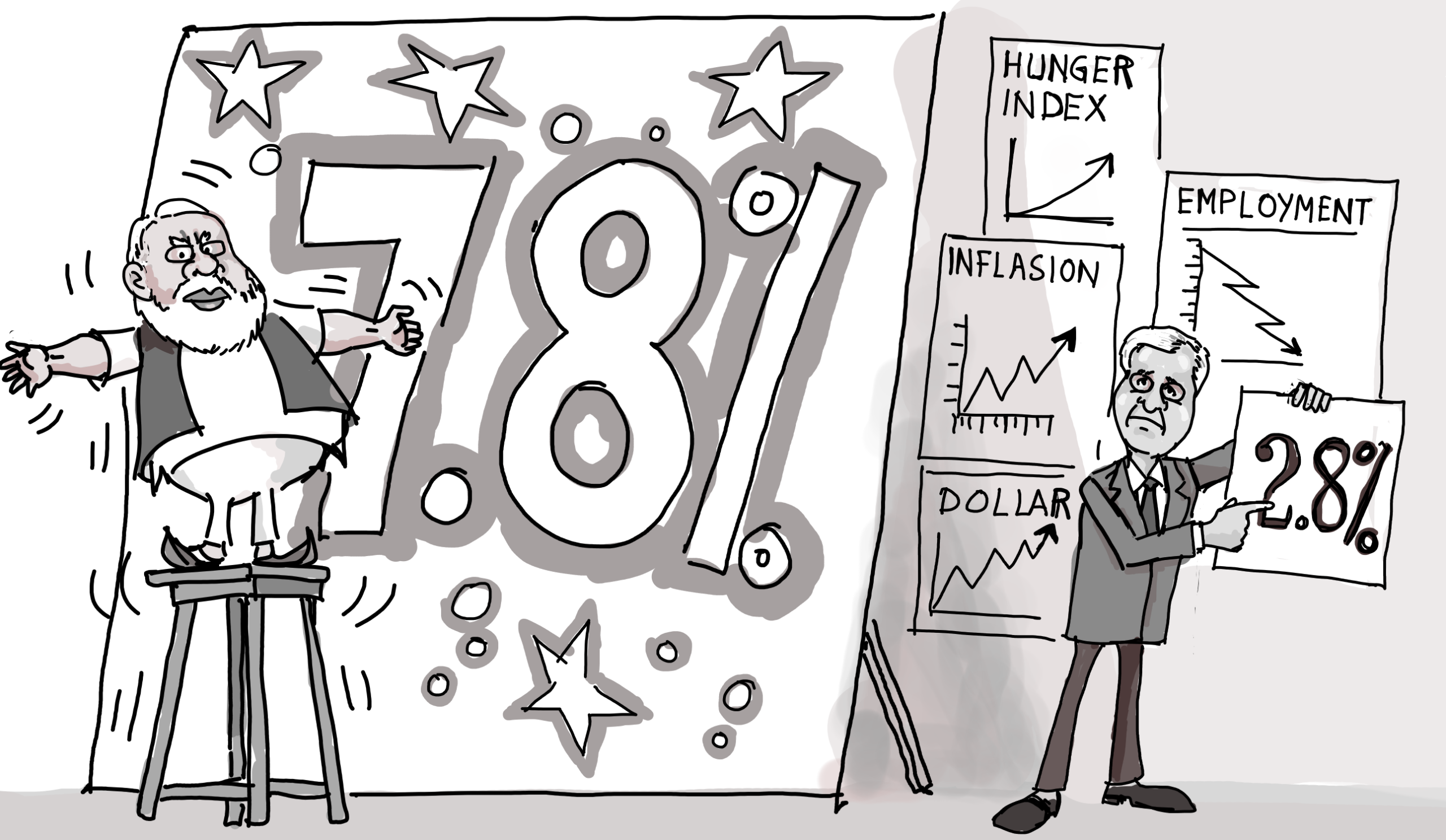
According to the latest govt data GDP growth is at 7.8%, but the figure has been challenged by none other than Subash Chander Garg; a former senior officer in the very Modi government. Former Finance Secretary Subhash Garg has said that the real GDP is around 2.6% and nowhere close to 7.8% as reports suggest. Dressed up figures may be nice to show progress; but real progress can be only achieved from knowing the ground reality.
Garg was appointed as an executive director in the World Bank by the Appointments Committee of the Cabinet (ACC) for a tenure of three years; Garg assumed the office of executive director on 10 September 2014, and demitted on 21 June 2017, because of his appointment as the Union Economic Affairs Secretary in the present dispensation. So, Garg is no leftist.
According to Garg “if they had not revised the last year’s GDP… the growth would have been 2.6%”. …. Even consider the assessment of former CEA Arvind Subramanian, whose research paper shows that India’s GDP has been consistently overestimated over the entire past decade. According to him, over the past decade we have actually grown at only around 4.5%. Everything else is rhetoric.
GDP is calculated in current prices; last year’s GDP is revised down so the growth percentage can be shown as high: the govt revised the last years Rs. 86 trillion (lakh crores) down to Rs. 80 trillion (lakh crores) to make the current figure seem better – thereby showing a higher growth rate.
The Rs 80 lakh crore estimate is based on the new 2022-23 series, which substantially changes the way several parts of the economy are measured. The problem becomes particularly obvious if we apply the same logic to real GDP. Under the previous series, real GDP in Q1FY26 was around Rs 48 lakh crore. Under the new series, it is around Rs 75 lakh crore. The economy did not suddenly produce Rs 27 lakh crore of additional goods and services. What changed was the statistical yardstick used to measure the economy. In the case of real GDP, the difference is even more stark because the two series also value output at prices from different base years. For a meaningful comparison between two periods, GDP has to be measured using the same methodology and data sources. Therefore, if Q1FY27 GDP is calculated using the new series, its Q1FY26 comparison must also come from the new series. Mixing Q1FY27 from the new series with Q1FY26 from the old series would essentially combine two different statistical frameworks. A direct comparison would therefore suggest that India’s real economy suddenly became almost Rs 27 lakh crore larger simply because the GDP series changed. This is the trick adopted by the Modi government to boost GDP figures and get the 7.8% high growth.
According to Macrotrend India gdp growth rate for 2026 was 4.86%, a 2.71% decline from 2025. India gdp growth rate for 2025 was 7.57%, a 0.47% increase from 2024. India gdp growth rate for 2024 was 7.10%, a 0.11% decline over the previous year. Overall, if one averages out these figures there has therefore been an actual decline in GDP growth rate. India’s GDP was $ 3.5 trillion three years ago and has increased to just under $ 4 trillion in 2025. While it increased at about 7% over the last three years it increased by under 5% in 2026. If adjusted for inflation the growth is much less.
The data claims that India has reached a significant milestone in its economic development, with gross foreign direct investment (FDI) inflows totalling an impressive US $1.16 trillion since April 2000. FDI equity inflows during FY26 increased to Rs. 5,6,936 crore (US$ 58,846 million), up from Rs. 4,21,929 crore (US$ 50,018 million) in the corresponding period FY25. The rise represents a robust 23% year-on-year expansion in rupee terms, reflecting continued strength in foreign investment activity and sustained confidence in India’s growth trajectory. But foreign investors only look for high returns, and is not a certificate for the economy itself.
India continues to be a global leader in remittance inflows as per the World Bank’s latest Migration and Development Brief released on December 18, 2023. The report has declared India as the global leader in remittances, receiving an impressive $125 billion in 2023. And Indians abroad remit part of their earning home because of the poverty of their relatives; not out of any patriotic intention.
Also, foreign investors only see their returns and safety of their investments and nothing else. The health of the Indian economy is not their concern. In fact, as already mentioned, according to Garg, GDP growth in Q1 in 2026-27 in current prices was a mere 2.6%, and in real terms close to 0. There are still messier distortions in sectoral performance with manufacturing and consumption witnessing negative growth…. ie an actual decline.
Economists Abhishek Anand, Josh Felman, and Arvind Subramanian published a paper at the Peterson Institute argued that India’s GDP has generally been overestimated by more than a fifth, and consumption by nearly a third.
Today it is getting more and more difficult to distinguish black from white. The Prime Minister’s degree was fudged. COVID deaths were fudged. Deaths in the Kumbh were fudged. The PM CARES Fund was fudged. The Census survey was fudged. SIR was fudged. Even AIIMS in Darbhanga was fudged. To this day, we keep finding fudging in the data on demonetization. So, is it really so difficult to imagine that there may not have been some fudging in the GDP data?
Playing games with data will not help the country to grow. One has to face the reality to solve a problem. Low growth means poor employment, increasing improvisation of the masses…..
India, like most other backward countries, is a country where nearly half our population are dependent on agriculture. All wealth has been handed over to the corporates where most of industry depends of foreign capital or capital in alliance with foreigners (comprador). If India is to grow into an advanced country it needs to take the following steps:
i) All Jal, Jungle, Jamin must be owned by the people and movements built in that direction particularly tribals must be given their rights and the corporate mafia destroyed.
ii) Reduce the size of the service sector and bureaucracy which acts as a leech on our body politics.
iii) Stop the drain of money and wealth abroad.
iv) Confiscate the wealth and property of the ultra-rich and the hundred-odd big business houses and utilise the money for the industrialisation of the country – SSIs and the development of agriculture. Thereby reduce the gap between the ultra-rich and the poor.
v) Tax all NRI wealth where possible, appealing to their sense of patriotism; and seize all hawala money and those stacked in tax havens.
vi) Reduce the size of our army, police and bureaucracy which sucks up our wealth without producing anything.
vii) Protect the environment and stop the rape of the earth for profit.
viii) Abolish the notorious caste system in our daily lives in both the economic base and superstructure; also, patriarchy in its varied manifestations (whether crude or subtle).
ix) Respect the dignity of labour; eradicate all Brahminical elitism.