

Aniruddha Poddar
“Dear women readers! Have you ever stopped to think about your wretched condition? What are we in this civilized world of the twentieth century? Slaves! We hear that the slave trade has been abolished from the earth, but has our slavery ended? No. Why are we slaves?”
(~ The Degradation of Women, c. 1903, Begum Rokeya Sakhawat Hossain)
Public conversation on women’s safety in India tends to follow a familiar arc. A crime shocks the conscience, outrage fills the airwaves, and the demand for tougher punishment gets louder. Once the news cycle moves on, the everyday arithmetic of how women negotiate public space is left largely untouched. Shaili Chopra’s Sisterhood Economy: Of, By, For Wo(men), which has found renewed relevance in the wake of recent events, asks that this arithmetic be examined. Her argument is that Indian women pay a “Safety Tax”; a levy that no legislature passes and no authority collects, but which is paid in full, generation after generation, by half the population. The metaphor is more than rhetorical. It offers a way of measuring what insecurity actually costs, and the figures that emerge are an indictment of the way Indian cities are planned and governed.

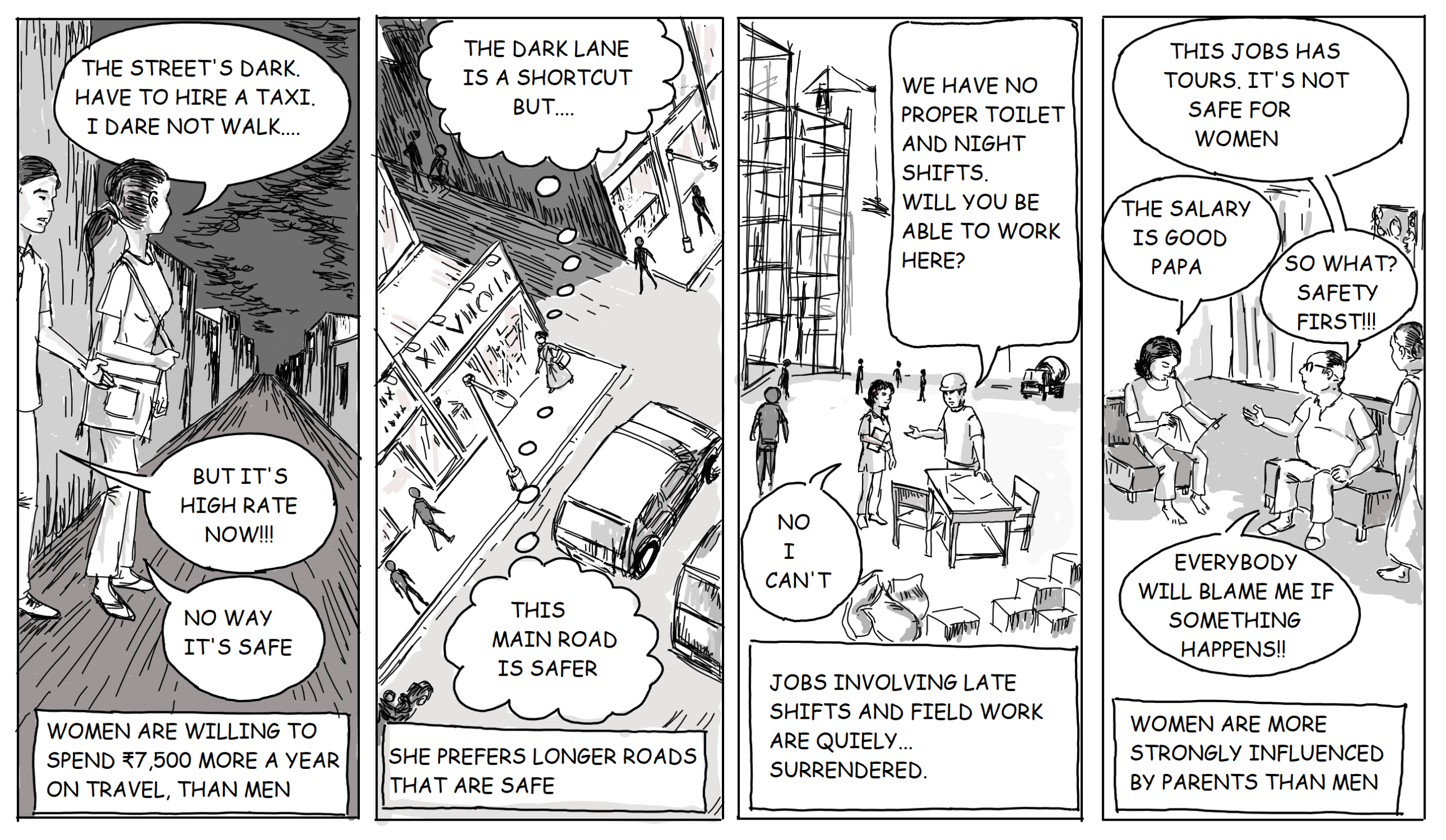
The tax falls due the moment a woman steps out of her home, and it is paid in four forms. The first is money. A woman who takes an auto or a cab because the bus feels unsafe spends more to travel the same distance, and no household budget records that premium as the price of insecurity. The same study found that women were willing to spend about ₹7,500 more a year on travel than men for a safer route, nearly 70 percent of the average annual fees at Delhi University.
The second is time. The shortest route is often not the one she takes. She prefers the longer road that is better lit and more crowded, and the minutes lost each day compound into a vast, unrecorded drain on her working life.
The third is opportunity. Jobs involving late shifts or fieldwork are quietly surrendered, so qualified women stay out of whole occupations, a loss that appears in no labour-force statistic. Combining these choices with earlier estimates of the earnings advantage of public colleges, it has been calculated that women’s willingness to pay for safety amounts to a 17 percent fall in the present value of their post-college salaries.
The fourth is the body. Public toilets are scarce on long journeys, and where they exist, fears about safety and cleanliness make women hold back for hours. Men can improvise; women, in practice, cannot. That a basic bodily need becomes a daily negotiation is a measure of how little public infrastructure has been designed with women in mind.
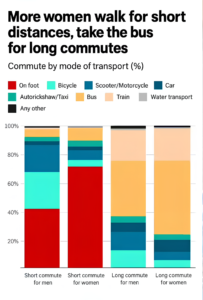
The burden is also unequally distributed. Women are more dependent than men on buses and trains because access to private vehicles is more limited, which makes many of them captive commuters. A well-off woman can offset the risk by paying for a cab. A poor woman has no such recourse, and she pays with her prospects. She may forgo the college or the job she is qualified for because the journey is too hazardous. Studies from Delhi suggest how stark the trade-off can be. One study of University of Delhi students found that women would accept a college nine percentile points lower in quality for a route that was one standard deviation safer. Men would give up only two points for the same gain in safety. Also they sometimes pay far more for the same course and travel longer distances, solely to stay on safer routes. When talent is turned away by an unsafe road, the loss is not private. It is a squandering of human capital that a country with a declining female labour-force participation rate can ill afford. The pattern extends beyond education. In 2017, the global labour-force participation rate for women was 26.7 percentage points lower than for men, with the widest gaps in emerging economies. In urban India, participation among women aged 25 to 54 stayed stuck at roughly 26 to 28 percent between 1987 and 2011, despite conditions that would normally push it up. The fear of harassment may explain part of this puzzle, and without women’s participation, India’s large working-age population cannot deliver its full growth dividend.
It may be objected that not all men pose a threat. That is true, but beside the point. The tax is levied on uncertainty, not on conviction. A woman cannot know in advance who is safe and who is not, and so she must price in the risk every time. Nor is this uncertainty visible to men, since those inclined to harass tend to behave differently in the presence of other men. The result is a gap in perception, what women experience as routine, many men rarely witness. There is also a question of who decides. In the study’s sample, women were significantly more likely than men to say their parents strongly influenced their choice of college, while men were more likely to say their parents had no say. Whether the fear belongs to the woman or to her family, the constraint is the same. This matters because a problem that is not seen is seldom prioritised, and the gap makes its way into the rooms where budgets are drawn up and cities are designed. This is why the framing of safety as a matter of policing alone is inadequate. Police reform, swift trials and fair investigation are necessary, but they address the aftermath of an offence. The Safety Tax is incurred before any offence occurs, in the decisions women make to avoid one. It can be reduced only by changing the environment; reliable and well-patrolled public transport, streets with adequate lighting, active frontages and visible public presence, and clean, accessible, well-maintained toilets. These must cease to be treated as civic niceties. They are the economic preconditions of women’s education, employment and mobility, and they belong in the foundational design of every transport and urban project, not in an addendum on “women’s safety.” Governments that audit their schemes for fiscal efficiency should audit them for this hidden cost as well, with data disaggregated by gender and journeys mapped by risk. What Ms. Chopra’s formulation demands, finally, is a change in how the problem is understood. A woman’s higher cost of moving through the world is neither natural nor inevitable. It is the product of institutional neglect, and it persists because those who pay it have long been told to regard it as the price of being a woman. A society that claims to value equal opportunity cannot go on collecting a tax from half its citizens and calling it prudence. The first step toward abolishing it is to count it.
Borker, Girija. 2021. “Safety First: Perceived Risk of Street Harassment and Educational Choices of Women.” World Bank Policy Research Working Paper No. 9731.
Chopra, Shaili. 2022. Sisterhood Economy: Of, By, For Wo(men). Simon & Schuster India.
Klasen, Stephan and Janneke Pieters. 2015. “What Explains the Stagnation of Female Labor Force Participation in Urban India?” The World Bank Economic Review 29(3):449–478.
ILO. 2017. “World Employment Social Outlook – Trends for Women.”.
Sekhri, Sheetal. 2020. “Prestige Matters: Wage Premium and Value Addition in Elite Colleges.” American Economic Journal : Applied Economics 12(3).
Zhang, Liang. 2005. “Advance to graduate education: The effect of college quality and undergraduate majors.” The Review of Higher Education 28(3):313–338.
Featured Image by Partha Chakraborty