

Partha Pathak
(Excerpt from his PhD thesis)
Conceptually speaking, the definition of religion for India as an organised order of belief and rituals does exclude vast areas of local, regional popular dogmas and practices of people, the Upanishadic, Christian and Islamic faiths in the superhuman controlling power. Thus, it keeps out of its ambit the early Buddhism, Jainism etc. as religions.[1] What is called Hinduism now is a mosaic of religious articulations and organisations, not a homogeneous concept. Noted historian Romila Thapar assertively stated, “Given the centrality of caste to religion, one’s religious identity drew substantially on caste, and therefore on birth”.[2] This crucial fact underscores as to why ‘the nature of religion is not similar to that of Europe’.
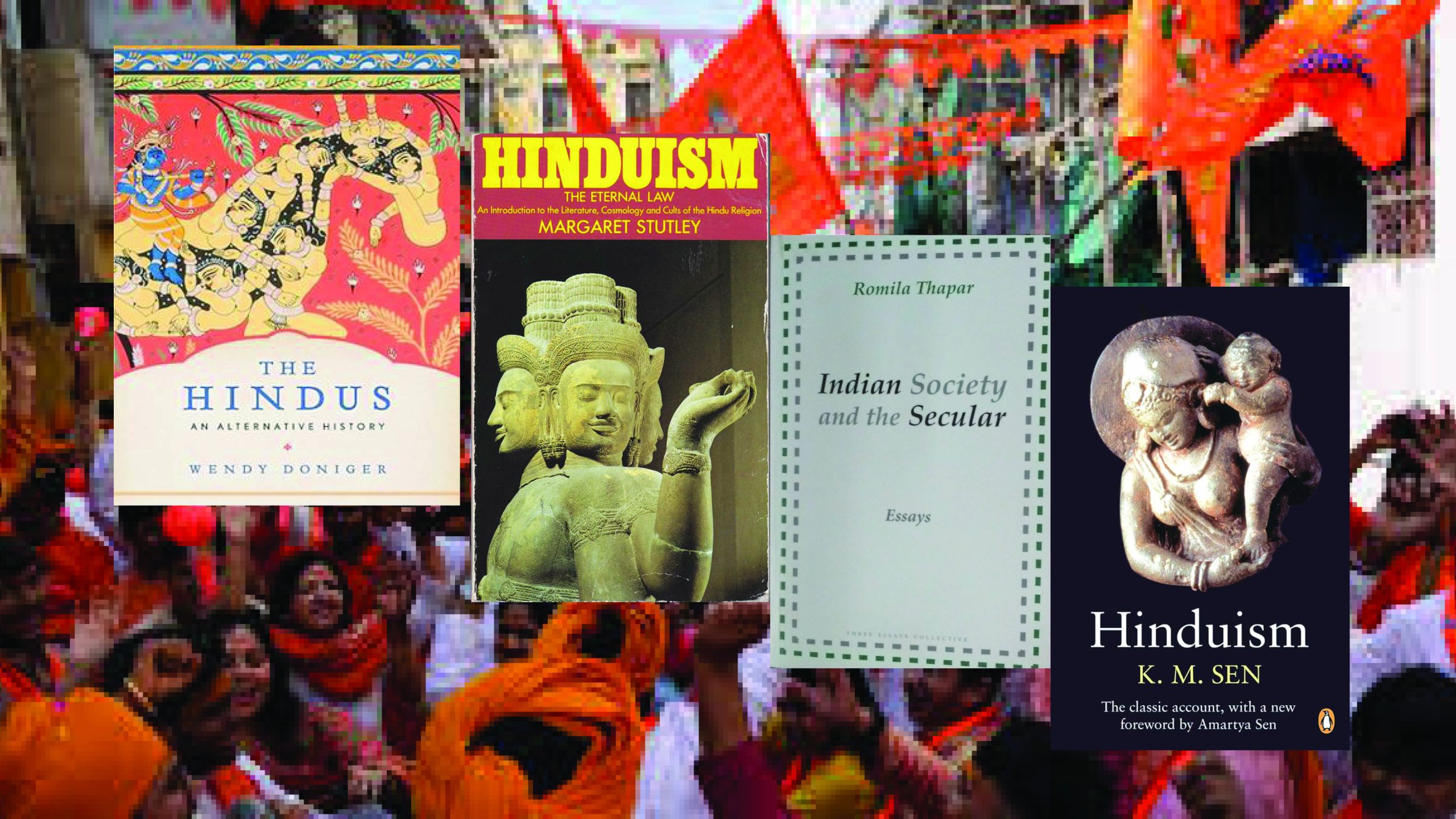
The term Hindu is derived from the river Sindhu (the Indus) as the Persians referred to the population in the land beyond the Indus. One noted scholar Khitimohan Sen opined that the term Hinduism appears to cover a generic meaning “for the religions of the people of India”.[3] Another noted scholar Margaret Stutley unequivocally stated that Hinduism was the name given by Europeans “to the religious, cultural, social, political and philosophical beliefs”.[4] Before British Imperialism there was not a comprehensive, self-determined and cohesive ‘Hindu’ religious group. The Persian word ‘Hindoo’ was used to identify the people surrounding the Indus river, which clearly demonstrates it was originally a term of external definition and not a self-determined identity. Under colonialism the Orientalists generalised various religious traditions somewhat into a coherent Hindu religion. Besides the Orientalists the role of colonial social structure through bureaucratic means like census, missionary crusade, etc. generalised a common adversary to fight concentratedly against coherent religious ‘Other’ Identified it as Hinduism.[5] Another recent scholar of religion was sharply categorical to forcefully assert that they turned many expressions of faith in India into the entity of Hinduism, “a term unknown in South Asia”. And “this imposed a false unity upon a variety of significantly different ways of rites and practices”.[6] To follow Wendy Doniger what is called now Hinduism is actually the proliferation of ‘polythetic polytheisms’ that go against the view of a single Hindu religion.[7]
Another much used term “Dharma”, in the sense of religiosity basically with god but also sans it, is an evolutionary concept. The eminent scholar Patric Olivelle stridently opposed the persisting colonial view positing two “central categories” i.e. “the concept of Dharma and the twice-born or Dwija” as defining categories of Indian civilization and of Hinduism as something unchanging. The term emerged as neologism (not found in cognate Indo-European languages including Avestan) in Rig Veda, its semantic range contains foundation, institute, moral order. In the vast Vedic and post- Vedic literature its use is infrequent. Patric Olivelle pointedly asserts with data that “the semantic range of Dharma is by and large restricted to the sphere of King, occurring most frequently within the coronation of the King, “not central in the theology and ritual exegesis of the Vedic texts and only marginal to the post-Vedic ritual literature”.[8]
For the anti-Upanishadic Buddha Dharma in Prakit (Sanskrit Dharma) as found in Ashoka’s inscriptions consisted of “a set of desired moral conduct and attitudes of mind” and of course liberality, etc. to Brahmins and Samanas.[9] However, out of so many Edicts one Rock Edict X, it was pronounced that for the high ranked person (usaṭa) it was more difficult to progress than for a lowly one; which amounts to a distinct inversion of the orthodox dharma, in which the higher ranks (varnas) had correspondingly greater access to religious merit.[10]
For the Jains Dharma is the universal rule of non-violence and against the Vedantic view they stated that there is no creator and the eternal law.[11] The term gained so much significance through Ashokan imperial ideology “that it was impossible even for the Brahminical tradition to ignore it………… first in the Sutras and then metrical treatises beginning with Manu………”.[12]
The term gained so much significance through Ashokan imperial ideology “that is was impossible even for the Brahminical tradition to ignore it………… first in the Sutras and then material treatises beginning with Manu………”.[13] The theistic religiosity encompassing “Life in totality” as the Hindutva Guruji Golwalkar forcefully presented to underscore the difference with the western notion of religion is a myth.[14] In the Manusmriti tradition the Arthashastra (1.3) elaborates: “This law (dharma) laid down in the three (vedas) is beneficial, as it establishes the duties (svadharma) according to the four Varnas and life’s stages (āshramas)”.[15] The dimension of this religio-social frame is doubtless wider than that of semitic religions devoid of the vice-like grip of Jati-Varna system.
Great variations in thought are present in the development of religious thoughts. While there is the Nasadiya Sukta in the Rig Veda (X,129) candidly expressing uncertainty about origins: “Who really knows? He who is in the highest heaven, he surely knows”, “or again, maybe he does not know”. This expressly rules out theology.[16]
Going beyond the Upanishadic absolutising God-centeredness even Kautilya’s Arthashastra is candid enough to state: “of the three ends of human life, material gain is, verily, the most important………On material gain depends the realisation of Dharma and pleasure”.[17] Thus Arth or material gain is privileged upon Upanishadic Dharma or Karma. Such pronouncement seems to be a compelling dictum, a leeway for the impact of counter currents represented by the Lokayata, Buddhism, Jainism, Ajivikas, etc. The same Arthashastra (1.3) rules in respect of caste Dharma: “This law (dharma) laid down in the three (Vedas) is beneficial, as it establishes the duties (svadharma) according to the four Varnas and life’s stages (āshramas)”.[18]
The religion based on the Vedas, Upanishads and Brahministic scriptures faced conspicuous changes from Buddhism, Jainism etc. alongside a plethora of sects (63 sects according to the Buddhist and Jain tradition). Going against atmaveda of the Upanishads Buddhism’s (Theravada Buddhism) denied the existence of God or Soul (anatmavad) was a corollary of the concept of non-eternal or momentariness (The Upanishadic idea of Soul being non-material, eternal and unchangeable).[19] In almost the similar vein in the early Jainism there is no creator, it never compromised with Upanishadic theism. Jain theorists never tired of attacking the idealist monism of Vedanta and Mahayana Buddhism.[20] Both the Buddhist and Jain philosophy declared their non-belief in the fruitlessness of the Vedic rituals.[21]
In consideration of the socio-economic background with the major changes in the mode and relations of production, especially with the advent of iron came in the wake of the rise of mahajanapaths with hundreds of rajas, proto-states with towns. The existence of Ganasanghas or chiefdoms and disintegration of tribal structure created ground for the anti-Brahministic religious currents. The Brahminite literature disapproved Ganasanghas for not performing rules of Varnas, rituals, etc.[22] From Ganasanghas emerged the Buddha, Mahavira etal.
The Buddha through his policy of moderation exhorted his lay followers to treat with consideration those who laboured for them and the possibility was made to remedy the harshness of life through an escape to the Shanga were all were considered equal regardless of Caste/Varna origin and where private property did not exist.[23] It was delineated as “economic communism”. The Buddha’s religion had its effect on Casteism/Varna system. One noted Marxist philosopher quoted Oldenberg’s view to substantiate the fact that “caste had no use for him”, although he did not use his influence to abolish it but tried to mitigate the severity of its rule.[24] He then follows Rhys Davids who mentioned that people of “mean origin” occupying important places in the Buddhist order and 8.5 percent of the order were of “base born”.[25] The metaphysical eternalist philosophy of the Upanishads applied to the social field defended the Varna system, slavery and domination by the so-called higher Varnas as something absolute that Buddhism opposed on the basis of dialectical philosophy of impermanence of everything and dynamism. In Maijhima Nikaya (2.147 ff), we came across a dialogue between the Buddha and Assalāyma, a Brahmin well-versed in the Vedas, where the Buddha unequivocally s dismissed the claim that Brahmins “are the true sons of Brahmā, born from his mouth, born of Brahmā, creation of Brahmā, heirs of Brahmā”. The Buddha refutation was that when they are Brahmins “born of Brahmin women who have their periods and conceive, give birth and nurse their children, just like any other women”. With such cogent logic the Buddha in his detailed discourse rebutted Assalayyana’s Brahmin superiority claim to conclude that “four classes are equally pure”. In the Buddhist order Kshatriya was posited above the Brahmins, thus the Brahmin superiority was undermined in theory was well. The Brahminist projection of natural divisions in the Vedic system is brusquely dismissed.[26] Worth it is to mention that India was known a Buddhist country for nearly a millennium.[27]
Like Buddhism Jainism flourished during the Mauryas. Challenging the idealism of Vedanta, dismissing the Vedic authority and that knowledge was only revealed to the Brahmin. The deity in any form was not central to early Jain a doctrine. Jainism thought that the universe functions according to an eternal law and is continually passing through a series of cosmic waves of progress and decline.[28] Such a concept was an antithesis Vedantism. In early Jainism there was no creator, it never compromised with theism. Jain theorists never tired of attacking the idealist monism of Vedanta and Mahayana Buddhism.[29] What was very important from philosophical points of Jainism was “view points” and “may be” both– both together are called Manysidedness, accepting seven possibilities (Anekantavada).[30] Both Buddhism and Jainism emerged from similar economic background. Jainism flourished under Mahavira during the Mauryas in Bihar and spread to the Pandyan country and Madurai and its epigraphic records of the late 3rd century and 2nd century BC confirm its receiving donations for monastic establishments.[31] The trading/class turned out to be its main followers. But neither Buddhism nor Jainism could effectively fight Brahminism or caste divisions. Despite being anti-Vedic tradition, Jainism unlike Buddhism, did not condemn the Varna system, Mahavira rather argued that a person is born in a high or in a lower Varna as virtues acquired or sins committed in the previous birth. However, he looked for human values even in a Chandal, and he considered lower castes can achieve liberation by leading pure and meritorious life.[32] However, like the fate of the Buddhist renouncers and their many followers, in everyday life the Jains gradually came to be influenced by Brahminism with idols being worshipped but at the philosophical level it considers its philosophy, an atheistic ascetic system of moral and spiritual discipline.[33] It is also stated that thought scrupulously differentiated from the gods of the Brahminic pantheon, Jain Tirthankars were ultimately given attributes of the Brahminical gods and are now worshiped. Further that, there are also Jain Brahmins to work for the Jain community.[34]
It is important to note here that while favoring Buddhism and Jainism the Kings required the rituals provided by Brahmins. In as little as 10th centuries a regional ideology i.e. Brahminism spread all over the sub-continent with the Sanskrit (a regional language) gained dominance. Even vast Buddhist literature and new inscriptions change into Sanskrit. Most of the early political risk inscriptions (not in Sanskrit) did not show awareness of 4-Varna divisions of Brahminism. In the changed scenario with the powerful movement of renouncers though not dismissed the favour of the Kings, yet failed to impress upon Kings “to give money to the poor and avoid violence in an environment of competing kingdoms”. The void was filled up by Brahmins for ritual and political guidance. The lay followers of Buddhism and Jainism too employed Brahmins for rituals at home. The Buddhists’ (also of the Jains) contributions in the fields of astronomy, mathematics, medicine and philosophy were left to the Brahmins’ to be useful for “rulers”. Buddhism and Jainism underwent drastic change coming down to “adopt a semi- Brahminical vision of society”.[35] The Buddhist adoption of a middle path by keeping themselves between theism and materialism, the belief in rebirth, Yogic mysticism, etc. as found in other religions or the “absolutist philosophy of Jainism” thus allowed Upanishadic views through backdoor.[36] D.D Kosambi in an earlier writing strongly rebutted the eminent sociologist Ghurey’s views of ‘revolution’ ushered in by Buddhism.[37] Nevertheless, the Buddhist tradition, treading the track contrary to Brahministic emphasis on Varnashram, duties, rigid conformity to Law Books with access to right to the privileged classes breathed into social life no single social code of laws, preferring customs and usage, human rights and a greater liberality permitting woman to become nuns.
The counter current of the Buddha ultimately yielded to neo-Brahminism for the inherent weaknesses but the role of Varnashramic Sanatan Dharma in taking resources to first accommodative process by referring him an avatara of Vishnu and then by virulent Brahminical intolerance towards Shramanas by means of large-scale prosecution, denigration, destruction of stupas and monasteries even when they proved to be no danger.[38]
It is worth nothing that not only Brahminism, Buddhism and Jainism through their submission to the caste system did play no less role in the diffusion of caste both in North and South India where religious preaching went hand in hand with the spread of the caste system in a significant way.
[1] Bhairabi Prasad Sahu, Society And Culture in Post-Mauryan India (200 BC – AD 300) In Irfan Habib, General Editor, Tulika books, pp.34-36.
[2] Romila Thapar, Indian Society and the Secular, Essays, Three Essays Collective, New Delhi, 2016, p.8 and pp.74-75.
[3] K.N Sen, Hinduism, Penguin Books, 1983, p.17.
[4] Margaret Stutley, Hinduism The Eternal Law, Indus, An Imprint of Harper Collins Publishers, New Delhi, 1993, p.8.
[5] D. Ludden, Making India Hindu, Oxford University Press, Oxford, 2007, Richard King, Orientalism and Religion, Routledge, London, 2006, Ben Heath, To What Extent Were Hinduism and India’s Caste System Largely ‘Invented’ by Europeans? Written at: Swansea University, May 2012.
[6] Martin Forward, Religion a Beginner’s Guide, One World, Oxford, 2006, p.28.
[7] Wendy Doniger, The Hindus An Alternative History, The Penguin Press, New York, 2009, pp. 27-28.
[8] Patrice Olivelle, The Changing India: Dynamism of Ancient Indian Culture, in Amitabh Matto, Heeraman Tiwari (ed), Cultural, People and Power, Shipra, New Delhi, 2014, p.106.
[9] Ashokas’s Eddicts RE III, IV, IX, XIII PE VII, Cited in Vivekananda Jha & Irfan Habib, Mauryan India 4, A People’s History of India, Aligarh Historians Society, Tulika Books, 2005, p.66.
[10] Ibid, p.66.
[11] A.L Basham, Jainism and Buddhism, In Ainslie T. Embree (ed) Sources of Indian Tradition, Penguin Books, Vol.1, 991, pp.80-82.
[12] Patrice Olivelle, op.cit, pp.106-7.
[13] Patrice Olivelle, op.cit, pp.106-7.
[14] Golwalkar, Bunch of Thought, p.72.
[15] Cited in Irfan Habib, Vivekananda Jha, op.cit, pp.66.
[16] Cited in Suguna Ramanathan “The Sanctity of Religious Disarmament, Economic & Political Weekly, June 21, 2018, p.29.
[17] Cited in R.N Dandekar, Artha The Second End of Man in Ainslie T. Embree (ed) Sources of Indian Tradition, op.cit, pp.241.
[18] Cited in Irfan Habib, Vivekananda Jha, op.cit, p.171.
[19] Rahul Sanskrityana, Buddhist Dialectics In Buddhism, The Marxist Appraisal, Peoples’s Publishing House, New Delhi, 9th Reprint, pp. 1 to 8.
[20] A.L Basham, Jainism and Buddhism, In Ainslie T. Embree (ed), Sources of Indian Tradition, Ibid, pp.80-83.
[21] R.K Bhattacharya, A Summary of Jain Philosophy In D.C. Sircar (ed), Religion and Culture of the Jains, Calcutta University, p.30.
[22] Romila Thapar, The Penguin History of Early India, Penguin Books, New Delhi, 2002, pp.138-139, 146-148.
[23] Uma Chakraborty, Everyday Lives, Everyday Histories: Beyond the Kings and Brahmanas of ‘Ancient India’, Tulika Books, New Delhi, 2007, p.129.
[24] Debi Prasad Chattopadhaya, Some Problems of Early Buddhism, In Buddhism, The Marxist Approach, People’s Publishing House, New Delhi, 2014, p.27.
[25] Ibid, p.11.
[26] Cited by A.L Basham in the Chapter Jainism and Buddhism, In Ainslie T. Embree, op.cit, pp.140-141.
[27] Amarta Sen, The Argumentative Indian, Penguin Books, New Delhi, 2005, p.56.
[28] Romila Thapar, The Penguin History of Early India, Penguin Books, op.cit, p.166.
[29] Ainslie T. Embree (ed) op.cit, In Chapter “Jain Philosophy and Political Thoughts”, pp.80-83.
[30] A.L Basham, Ibid, p.78.
[31] Irfan Habib, Vivekananda Jha, A People’s History of India, Mauryan India, 4. Tulika Books, 2005, p.145.
[32] R.S Sharma, India’s Ancient Past, Oxford University Press, New Delhi, 2019, p.134.
[33] Ainslie T. Embree (ed) op.cit, The Chapter “The Basis Doctrine of Jainism”, p.57.
[34] A. Lahiri, The Conceptions of Tirthankars, In Jain Mythology, In D.C Sircar’s opinion in the same book, p.6.
[35] Johannes Bronkhorst, Rethinking India’s past, In Amitabha Matto, Heraman Tiwari (ed) Culture, People and Power, India And Globalised World, Shipra, New Delhi, 2014.
[36] Y. Balarammoorty, Buddhist Philosophy In Buddhism, The Marxist Approach, op.cit, p.49.
[37] D.D Kosambi,
[38] Details Cited by D.N Jha, Brahminical Intolerance in Early India, Social Scientist, 516-517, May-June 2016.
 editor