
Kobad Ghandy
In the 34th annual Forbes list of the world’s billionaires, [2023] the list included 2,095 billionaires with a total net wealth of $8 trillion – over twice the size of India’s GDP. And this continues to rise no matter what the crises.
The US trade deficit, which ballooned to $918.4 billion in 2024, is cited as evidence of a broken system. However, critics agree that Trump’s remedies are self-defeating. According to various sources, these tariffs may cost the average US household $3,800 annually in higher consumer prices. According to John Bellamy Foster, the US is now governed by a “tech-finance oligarchy”, with billionaires like Elon Musk, Peter Thiel and Tim Mellon directly shaping federal policy. The 2025 Trump cabinet includes at least 13 billionaires with a combined net worth of as much as $460 billion (Monthly Review).
Trump’s second term is fuelled by intellectual architects like the Heritage Foundation (The Heritage Foundation and Heritage Action are fighting to restore self-governance so that all Americans can live the good life. Conservatives must set the agenda, earn a mandate for that agenda, and govern accordingly. Over the next two years, we will engage in Washington to dismantle the deep state and in the states to restore the family, rebuild American institutions, and restore opportunity for all. We are committed to promoting human flourishing for all Americans and championing the policies that get us there. Heritage will advocate for America to protect its sovereignty, defend its borders, and defeat globalism.) – probably a CIA – fascist outfit.
The US has imposed new duties on South African steel and autos, while signalling a possible exit from AGOA (African Growth and Opportunity Act). Trump is also threatening tariffs all across the globe. Trump’s revival of aggressive tariff strategies has created ripples across the Global South. Countries like South Africa, Mexico and other countries, previously seen as potential beneficiaries of US supply chain diversification, are instead facing punitive tariffs. Dean Baker warns that such tariffs are inherently regressive, hurting low-income households more than the wealthy. Under Trump, trade policy has become weaponized. The administration’s commitment to the Heritage Foundation’s Project 2025 has resulted in the systematic dismantling of multilateral trade institutions. In fact Peter Navarro’s chapter in Mandate for Leadership goes so far as to call for abandoning WTO principles and replacing them with the US Reciprocal Trade Act, allowing unilateral tariff hikes to match foreign rates.
The barrage of actions by US President Donald Trump has shocked the country’s research community over the past two months. Yet, much of it was planned out years in advance and laid out publicly.
The Heritage Foundation, a right-wing think-tank based in Washington DC, released Project 2025, a policy guidebook and staffing list, in April 2023, as a blueprint for what it hoped would be a second Trump presidency. Trump, however, disavowed the initiative during his 2024 presidential campaign, saying that he had no knowledge of it, after there was a public backlash over the publication’s sweeping Republican policy proposals, such as banning abortion, overhauling the federal government and slashing funding for climate science.
But Trump and his administration have closely hewed to Project 2025’s agenda, detailed in a sprawling, 922-page book, passing executive orders to defund climate initiatives and target diversity programs. The Wall Street Journal found that more than half of Trump’s executive orders (EOs) align with Project 2025 recommendations. And most of its 40 listed authors are now key figures on Trump’s team.
President Trump is implementing the America First agenda he campaigned on to free up wasteful DEI [diversity, equity and inclusion] spending for cutting-edge scientific research, roll back radical climate regulations and restore America’s energy dominance.” But policy watchers expect that the president’s upcoming budget request to the US government will contain massive cuts to science agencies.
Here, Nature examines science-related policies from Project 2025 that have already come to pass, and which ones might be on the horizon.
Has Trump ever followed the think-tank’s advice before?
The Heritage Foundation has been publishing policy recommendations since 1981, often timing them for a new presidency. At the start of Trump’s first term in 2017, the foundation listed hundreds of priorities, such as opening up sites for off-shore oil drilling. According to the foundation, after a year in office, Trump had followed through on 64% of them.
Compared with previous guidebooks, Project 2025 advises more extreme actions. For instance, whereas the 2017 version advised the president to “rein in the administrative state”, Project 2025 advocates that the president “dismantle the administrative state”, which employs more than two million federal workers. And its proposals don’t apply only to the federal government: Project 2025 also aims to reform the US education system, including universities. The goal, its authors write, is to “defang and defund the woke culture warriors who have infiltrated every last institution in America”.
In reaction to Trump’s aggressive policies China is intensifying regional cooperation through the Regional Comprehensive Economic Partnership, while developing a digital yuan to reduce dependence on the dollar. BRICS nations are exploring new payment platforms amid Trump’s threats and persuasions, challenging the hegemony of US-dominated financial systems. Russia and Iran have strengthened barter and local-currency trade mechanisms, a signal of increasing resistance to dollar-based trade.
Europe, too, is reconsidering its position. Thomas Piketty observes that Trump’s “national capitalism likes to flaunt its strength, but it is actually fragile” and urges Europe to ‘regain confidence’ and ‘forge new alliances’. While some European leaders remain hesitant, others are calling for a more assertive stance on trade, technology and environmental governance.
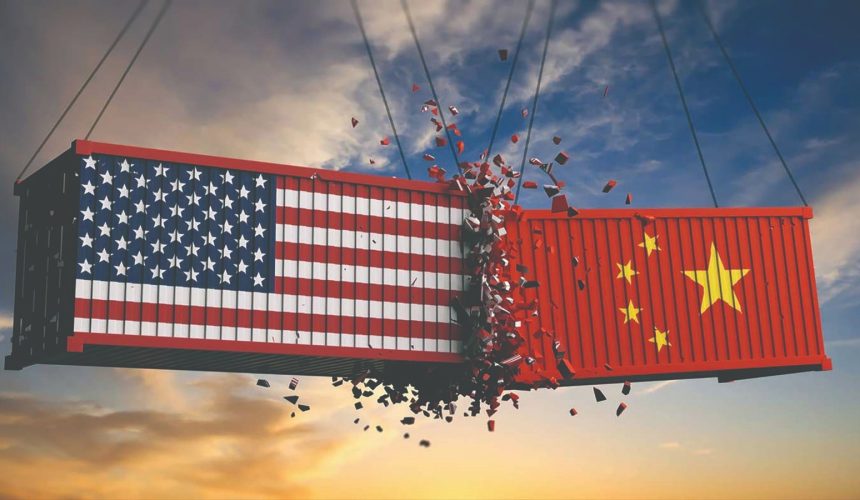
At the international plain though the US is still the main hegemon, China is fast catching up. The contention is already visible and is bound to grow. It is reflected in the Ukraine conflict where Russia is backed by China and Ukraine relies on NATO arms. Also, in the recent Isreal Palestine conflict, the US, as always was strongly behind Isreal, while China, though hesitantly, is with the Palestinians. The next flashpoint is likely to be the Taiwan straits. China and Taiwan are both making aggressive noises.
In fact, a war situation is brewing in many parts of the world – recent being India-Pakistan. India has no role to play in this international scenario and they are rarely mentioned. Though clear cut blocs have not yet emerged it is coalescing into a US-Isreal bloc vs a China-Russia bloc. But many countries, including India are still sitting on the fence.
In 2024, the gross domestic product (GDP) of China amounted to around $20 trillion (2023). US is $ 30 trillion, the EU comprising 27 countries, is $ 18.6 trillion, India’s is $4 trillion in 2023. But China’s growth rate is 4-5% to the US’s & EU is around 1%. This gives a picture of the relative strengths of the respective blocs and also of the future. The EU is not homogenous and many go their own way politically.
The imposition of retaliatory tariffs by China, the EU and others has already begun to distort trade flows. Vietnam, a major exporter to the US, has seen supply contracts redirected to other Asian economies. Even allies like Canada and Germany find themselves under threat of new trade barriers. The net effect is a fragmentation of global trade into politically motivated regional spheres (Monthly Review)
How Trump is following Project 2025’s reactionary roadmap to defund science, through indiscriminate firings, terminating grants and cancelled programmes. Project 2025 notes that the US president has sole authority over the US executive branch, which includes many science agencies, and encourages the president to exercise it. Trump has so far followed this philosophy, using EOs to accomplish his wishlist. (EOs direct the US government to take action but cannot contravene laws.) Many are being challenged by lawsuits.
The contentions are growing world wide and this is without any economic crisis. None is fortunately looming in the near future, so this slugfest will continue without erupting into a major war. Once the economic crisis deepens – maybe by end next year or 2027 – these localized skirmishes will evolve into a major confrontation. One only hopes nuclear war heads will not be used.


अंतराष्ट्रीय परिस्थिति की एक बेहतरीन व्याख्या है। इसके अलावा इस अंक में कई पठनीय आलेख हैं।