
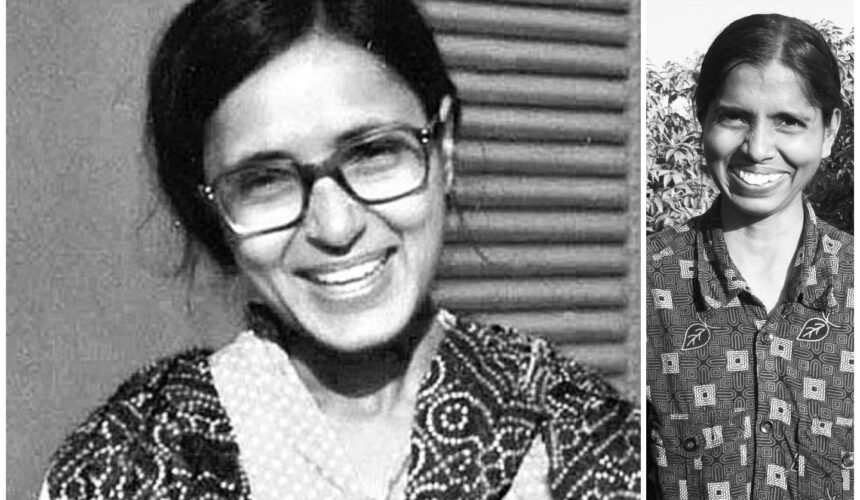
Aman
April 12 marks the 18th death anniversary of Comrade Anuradha Gandhi. She passed away in 2008 after a severe illness, at the age of 54. A central leader in the revolutionary movement, Anuradha was an intellectual who produced significant theoretical writings on Hindutva, feminism, and the caste question.
Born into a middle-class intellectual family in Mumbai, she pursued higher education. But she later gave up everything to work among Adivasis in remote regions such as Bastar and Jharkhand. An inspiring teacher, she conducted political classes for activists working in these areas. Her analyses and theoretical contributions will endure forever.
In the wake of Anuradha’s martyrdom, International Women’s Day on March 8, 2009, was observed in her memory across many parts of the country. On that occasion, an important pamphlet released by the revolutionary movement was drafted by the revolutionary writer and activist Comrade Renuka. Coincidentally, Renuka too was 54 when she was killed in a staged encounter on March 31, 2025, after suffering from severe illness and being caught alone by enemy forces.
The following are excerpts from what Renuka wrote in that pamphlet about Anuradha’s contributions:
“Many women are proudly carrying forward the legacy of March 8. In doing so, they face countless hardships with unwavering determination. When necessary, they sacrifice their lives and remain in history as heroic women. Among such heroines, Comrade Anuradha Gandhi must be mentioned foremost.
The life of Comrade Anuradha, who passed away on April 12, 2008, due to cerebral malaria, is deeply inspiring. Born into a petty-bourgeois family in Mumbai, she pursued higher education, joined as a lecturer at Nagpur University, and gained recognition as an intellectual. Yet she did not remain confined to books, colleges, or lectures. She stood shoulder to shoulder with the working class, grasped working-class politics, and chose the path of armed struggle for working-class state power. She participated in movements for democratic rights and helped build movements for a new democratic culture. She consistently worked to organise workers, Dalits, Adivasis, and women along the path of the new democratic revolution.
Advancing further on this path, she gave up her job and a comfortable life and chose to live underground. Responding to the Party’s call, she embraced forest life and took up arms to organise Adivasis. With her remarkable intellect, she played a significant role in strengthening the Party in the theoretical sphere.
In particular, she made notable contributions to the theoretical understanding of caste and women’s issues. Owing to her many capabilities, she took on important responsibilities within Party structures. She served as a member of the Maharashtra State Committee and, at the Unity Congress held in January 2007, was elected to the Central Committee, taking charge of the women’s movement at the national level. It was while discharging these responsibilities—when she had gone to Jharkhand to conduct political classes for women comrades—that she contracted cerebral malaria, which eventually took her life.
In a semi-colonial, semi-feudal society deeply intertwined with patriarchy, Comrade Anuradha broke through numerous barriers faced by women and rose to become a Central Committee member of a working-class party. She took up the task of organising ‘half the sky’ for working-class state power. She stands as a proud inheritor of the legacy of March 8, International Women’s Day of struggle. On this March 8, let us uphold and propagate her revolutionary life, her contributions, and the ideals and values she established. Let us take it as the call of March 8 to fulfil her unfinished aspirations and dreams.”


