

Kamal Singh
Fight against the war-monger imperialism and its lackeys!
Take away Red flag from Revisnaists
March forward on road of socialism
“The workers of Paris chose the red flag during the June 1848 uprising because they viewed it as a symbol of ‘the proletariat’s own state power.’ The red flag had now become not merely a signal of proletarian revolt, but a symbol of class-consciousness.” — Karl Marx (The Class Struggles in France
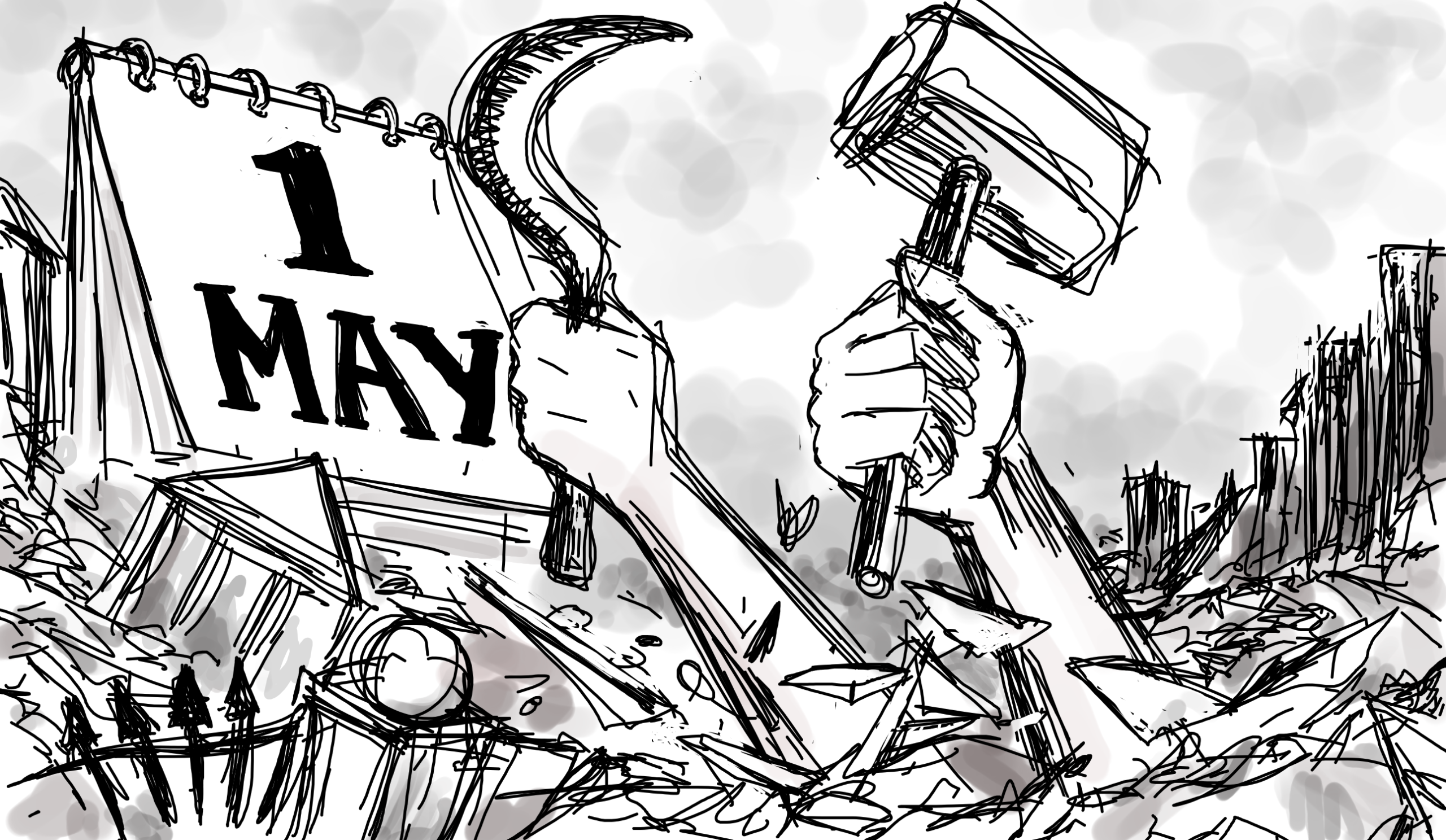
May Day is the day of the working class’s struggle to seize state power—the day of the Red Flag. To confine it merely to reforms within the capitalist system, or to limit it to economic or partial demands, is a betrayal of the working class’s revolutionary struggle against capitalism; it amounts to reducing the working class to a mere appendage of the capitalist class. In India, under the guise of opposing fascism, an attempt is being made to turn the working class into a camp-follower of the ruling class’s Congress-led “soft Hindutva” faction, in opposition to the ruling class’s own aggressive Hindutva-fascist faction. Both fascism and parliamentary democracy (constitutional democracy) are, in essence, forms of capitalist dictatorship. The current Modi government represents a continuity—both economically and politically—of the Manmohan government; it is an anti-people and anti-labor government.
Politics of working class
May Day has a specific political significance. Unity of the working class can be based on revolutionary politics of the working class. The struggle for an eight-hour workday is, in essence, a continuing struggle to replace capitalist democracy with a new socialist order. The Red Flag serves as the symbol of working-class politics. The history of May Day—a history of militant struggle for the eight-hour workday—constitutes a glorious chapter in the history of the Red Flag.
The History of the Red Flag
The Red Flag is the banner of workers across all nations. It is the flag of the workers’ state. The history of the Red Flag is a history of revolution, sacrifice, and the struggles of the working class. The Red Flag emerged against the backdrop of a tragic event: during the period of martial law—declared by the Mayor of Paris—the “National Guard” opened fire upon a crowd gathered in the vast grounds in front of the Eiffel Tower (the Champ de Mars). Their demand was the removal of King Louis XVI; dozens of people were killed. Since that time, the Red Flag has stood as a symbol of the struggle against state repression, representing the “blood of martyrs,” the liberation of the people, and of revolution. (The Eiffel Tower—one of the Seven Wonders of the World—is a colossal structure, standing 330 meters (1,083 feet) tall—equivalent to an 81-story building—and constructed from approximately 18,000 iron components and 2.5 million rivets.)
During the revolutionary class struggles in France in 1848, workers and students organized themselves and raised their voices for socialist democracy (social democracy) —replacing the Bourgeois democrcy accordingly replacing the tricolor flag (the symbol of Liberty, Equality, and Fraternity) symbol of Bourgeois democrcy with Red flag as a symbol of social democracy. In the words of Karl Marx: “The workers of Paris chose the red flag during the June 1848 uprising because they viewed it as the symbol of the proletariat’s own power… The red flag had become not merely a signal of rebellion, but a symbol of class consciousness.” (ref : The Class Struggles in France). The Paris Commune (March 28, 1871, to May 28, 1871) marked the world’s first instance of working-class rule. The red flag was the banner of the Paris Commune—the flag of the workers’ state.
May Day and the Red Flag
In 1986, in the city of Chicago of the constitutional democratic government of the USA,—led by capitalists, who claimed that they are the government “of the people, by the people and for the people’”—brutally suppressed a militant workers’ movement demanding an eight-hour workday. A farcical trial was staged against the arrested labor leaders; on November 11, 1887, four of the eight arrested leaders—August Spies, Albert Parsons, Adolph Fischer and George Engel—were executed on fabricated charges.
Even today—whether in America or India—those who champion constitutional democracy and the impartiality of the judiciary are by no means lacking in cruelty. In India, in the wake of its so called independence, instances of such cruelty range from the military suppression of the Telangana Peasant Movement (1946-51) by the Nehru government and massacres in Jammu and Kashmir, to the sweeping powers granted under AFSPA (Armed Forces Special Powers Act)—allowing for arrests without warrant, unbridled authority to open fire. This includes the fascist repression carried out under the ‘Disturbed Areas Act’ across the Northeast—including Nagaland, Manipur, and Mizoram—as well as the ongoing suppression in major Naxal-affected districts of Chhattisgarh (Bastar), Jharkhand, Odisha, West Bengal, Bihar, Andhra Pradesh, Karnataka, Madhya Pradesh, and Uttar Pradesh. This latter campaign is conducted in the name of quelling Naxalism (Maoism) through operations such as ‘Operation Green Hunt’ and ‘Operation Kagar’ against the Communist Party of India (Marxist-Leninist-Maoist). Furthermore, it is a common occurrence for socio-political activists to be detained for years without charge sheets or trials under laws like the National Security Act and UAPA; likewise, in the name of eradicating Naxalism (Maoism)—and in the service of capitalist interests to facilitate the corporate looting of mineral resources—the continuous repression on movements of toiling classes through firing, helicopter strikes, and unmanned drones remains a routine reality.
May Day and the International Workers’ Association
The demand for an eight-hour workday—commemorated on May Day—was spearheaded by the International Working People’s Association (IWPA), also known as the “Black International.” Its banner was a black flag, symbolizing “sorrow, hunger, and rage.” This organization was formed in 1881 under the leadership of Bakunin, following a split within the First International Working Men’s Association, which had been established in 1866.
Initially, within the First International (1864–1876), there existed a two-line struggle between liberal reformists, some trade union leaders and anti-capitalist revolutionaries. Both Marxists and anarchists represented the revolutionary line advocating for the abolition of capitalism. Reformist liberals, on the other hand, favored socio-economic reforms in the interest of workers within the framework of the capitalist system—specifically, “constitutional democracy.” Meanwhile, ideological differences and debates regarding the lessons drawn from the working class’s defeat in the Paris Commune also existed between the Marxists and the anarchists. During his analysis of the historical lessons of the Paris Commune, Karl Marx formula the concept of the “Dictatorship of the Proletariat” (working-class state power) as a key lesson. According to Marx, Marx argued that the working class cannot merely take possession of the existing state machinery, but must destroy it. He said the working-class state—established after the overthrow of capitalist power—would serve as an instrument of class struggle throughout the long transitional phase from socialism to communism (i.e., a society devoid of private property and class distinctions). Conversely, proponents of anarchist theory—such as Bakunin and Peter Kropotkin—argued that the capitalist state should be dismantled through “direct action,” and that the institution of the state itself should be abolished immediately therewith. They were vehemently opposed to the Dictatorship of the Proletariat (working-class state), viewing it as a repressive regime controlled by a new bureaucratic class and as a force inimical to individual liberty. This conflict between the “Red Flag” and the “Black Flag” constitutes an integral part of the ideological history of May Day. Following Marx’s death (in 1883), the second international organization of the working class—the Second International (1889–1916)—declared May 1st as International Workers’ Day during its inaugural conference (1889), held in Paris as the International Socialist Congress, in commemoration of the martyrs of Chicago. The history of the Red Flag is, in essence, the history of May Day and the broader socialist movement.
The Communist International
The Era of Imperialism and Proletarian Revolution
During the First World War, the leaders of the Second International fell prey to bourgeois nationalism and became lackeys of the imperialist capitalists in a war of competition for the plunder of colonies. They betrayed the Red Flag. Under the leadership of Lenin, with the Socialist Revolution in Russia in 1917—and the subsequent establishment of the Soviet Union under the dictatorship of the proletariat—the Red Flag of the working class was adopted as the banner of the Red State Power.
The present era is the era of imperialism. Instead of economic growth and the development of productive forces, it is a system characterized by the monopolisation of capital, economic recession, unemployment, colonial and neo-colonial plunder, war, and aggression. This represents the terminal stage of capitalism— moribund capitalism . This very system of plunder and exploitation lies at the root of the ongoing wars, genocides, arms race, and the looming threat of nuclear Catastrophe plaguing the world. American, Russian, and Chinese imperialism—along with the capitalist nations of Europe, notably Britain, France, and Germany—constitute the dominant imperialist powers. Standing in opposition to them, the colonial and neo-colonial nations and their populations—as well as the working class and toiling masses in every country—are engaged in a relentless struggle. These national liberation movements and the global revolutionary struggle of the proletariat represent the ongoing fight for the establishment of a socialist order. A war is currently unfolding between the US-European bloc (NATO) and Russian imperialism over the issue of Ukraine. In the Middle East, Israel and the United States are unleashing violence, war, and aggression to plunder the raw materials, oil, natural gas, and resources of the middle east. Nations such as Palestine and Iran are their main targets. Across all nations— —working-class movements and struggles against pro imperialist classes are intensifying.
Inequality and Poverty
Out of the world’s total population of eight billion, more than one billion people live in extreme poverty. The largest number of these individuals resides in India (234 million). Inequality is rising at an alarming rate, both globally and within India. According to the Global Inequality Report 2026, the wealthiest 10 percent of the population holds 75 percent of the total wealth. In contrast, the bottom 50 percent—the working masses—possess a mere 2 percent of the total wealth; indeed, the richest 0.001 percent control three times more wealth than the entire bottom half of humanity combined.
In India, the wealthiest 10 percent capture 58 percent of the national income, while the top 1 percent own 40 percent of the country’s total wealth. Evidently, how can industry and the economy possibly grow when the masses lack purchasing power and wealth continues to be concentrated in the hands of a select few? The current economic downturn—a recession far more severe than those witnessed during the eras of the First and Second World Wars—lays bare the crisis inherent in the imperialist-capitalist system. The policies adopted in the name of globalization—specifically liberalization and privatization—aimed at opening markets to imperialist capital and driving economic reform, have proven to be a failure. Far from diminishing the economic crisis and reducing inequality, these are intensifying rapidly. It constitutes the root cause of the current predicament. The rise of neo-fascism, along with the proliferation of wars and ever-expanding defense budgets, represents the abyss into which humanity is currently being thrust.
May Day and the Task of the Working Class movement
The primary task of the working class is revolution. It has to integrate economic struggles with the struggle for overthrow state power. In India, the strategy of “Save Democracy, Save the Constitution”—adopted to oppose fascism—must not be utilized merely to exploit the internal contradictions of the ruling class. Due to stunted industrial growth, the weakening of the organized industrial working class has undermined the efficacy of strikes and struggles aimed at securing the economic demands of workers and tolling masses. The militancy of the trade union movement has been blunted, forcing it into a defensive posture. The division between regular and contract workers within industries has further emasculated the trade union movement. The eight-hour workday is being supplanted once again by work shifts lasting anywhere from 10 to 14 hours. All labor laws—including the rights to organize and form unions—which workers had secured through arduous struggles, are systematically being stripped away.
Picture: Partha Chakraborty